How the Al Qalam sign text changed

This page compares the original sign that framed the community through the historical category “Greater Syria” and “Syrians” with the revised sign that separates the writers and residents into present-day Lebanese and Syrian identities.

Visual evidence

The two signs

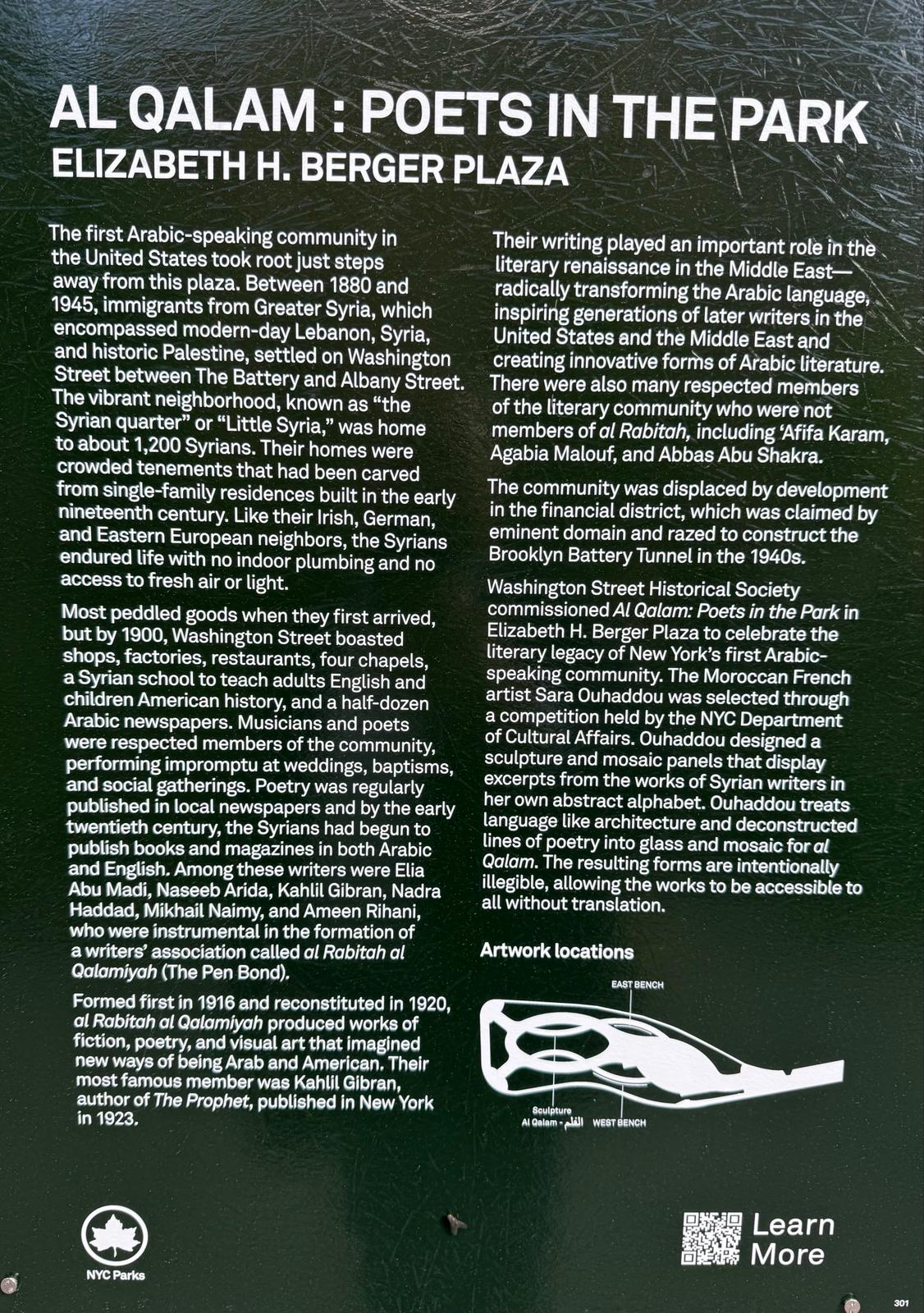
Original Al Qalam sign describing immigrants from Greater Syria and the neighborhood as the Syrian quarter or Little Syria.
Original sign. Uses “Greater Syria,” “the Syrian quarter,” “1,200 Syrians,” and “Syrian writers.”
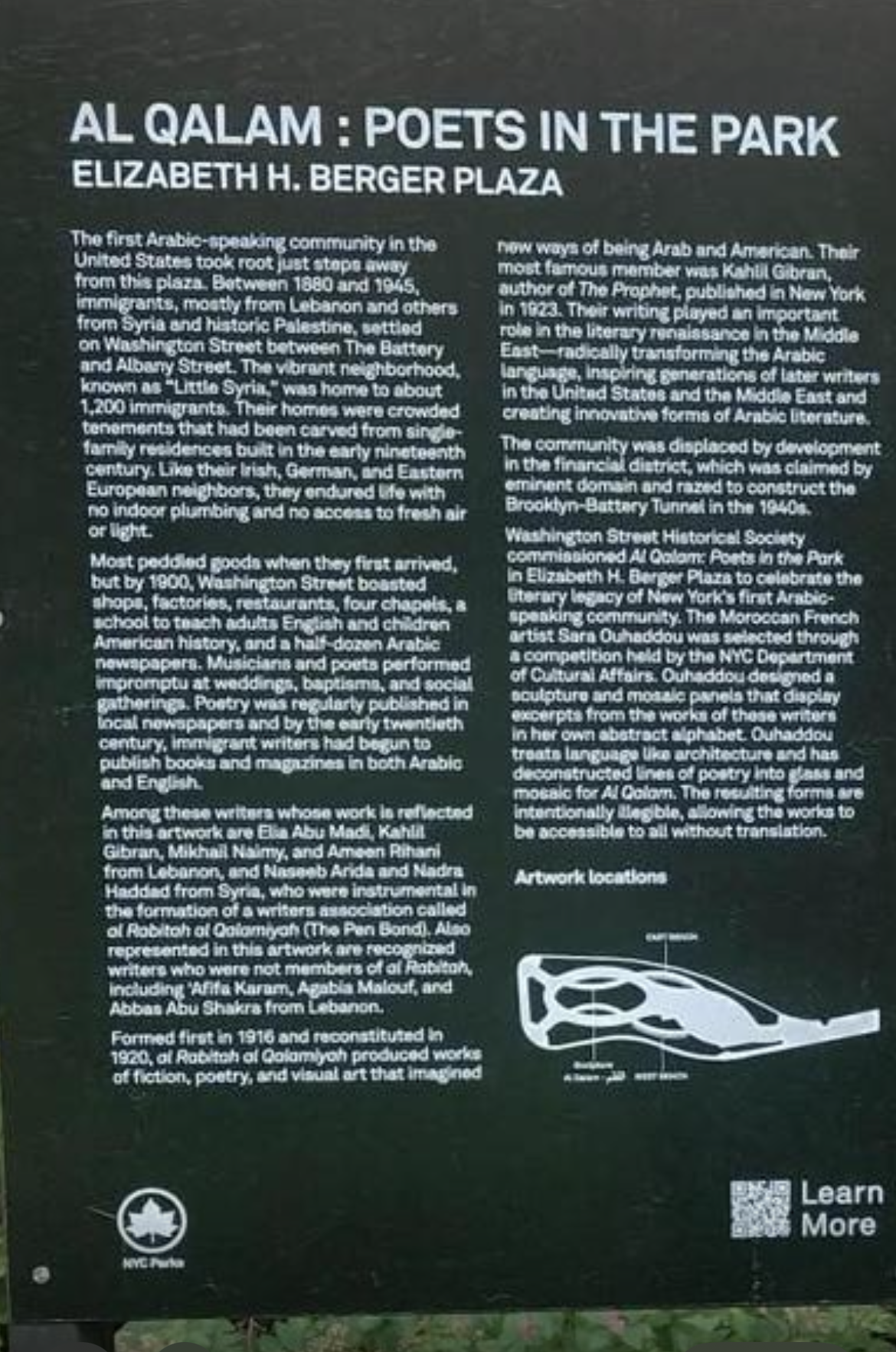
Revised Al Qalam sign describing immigrants as mostly from Lebanon and others from Syria and historic Palestine.
Revised sign. Uses “mostly from Lebanon,” identifies specific writers from Lebanon and Syria, and removes several collective uses of “Syrian.”

Change map

What changed in meaning

Issue
Original wording
Revised wording
Effect
Origin frame
“immigrants from Greater Syria, which encompassed modern-day Lebanon, Syria, and historic Palestine”
“immigrants, mostly from Lebanon and others from Syria and historic Palestine”
Replaces an Ottoman-era regional umbrella with a present-day national sorting.
Neighborhood name
“the Syrian quarter” or “Little Syria”
“Little Syria”
Keeps the historical place name but removes the explanatory synonym “the Syrian quarter.”
Community count
“home to about 1,200 Syrians”
“home to about 1,200 immigrants”
Changes the population label from an ethnonym to a migration-status term.
Shared hardship
“the Syrians endured life”
“they endured life”
Avoids repeating “Syrians” for the whole community.
School description
“a Syrian school”
“a school”
Removes one more institutional use of “Syrian.”
Poets’ community status
“Musicians and poets were respected members of the community, performing…”
“Musicians and poets performed…”
Removes the evaluative phrase “were respected members of the community” and changes “performing” to “performed.”
Literary producers
“the Syrians had begun to publish”
“immigrant writers had begun to publish”
Shifts the subject from the community as “Syrians” to a narrower group of writers.
Writer-list paragraph break
The writer list continues in the same paragraph after “both Arabic and English.”
The writer list begins a new paragraph after “both Arabic and English.”
Gives the named-writer attribution its own paragraph in the revised sign.
Rabitah writers
Lists Elia Abu Madi, Naseeb Arida, Kahlil Gibran, Nadra Haddad, Mikhail Naimy, and Ameen Rihani without national origins.
Adds “whose work is reflected in this artwork,” reorders the names, and labels Abu Madi, Gibran, Naimy, and Rihani “from Lebanon,” and Arida and Haddad “from Syria.”
Makes modern nationality the organizing device for the named authors and changes the sentence’s lead-in.
Non-Rabitah writers
Says there were “many respected members” outside al Rabitah, naming ‘Afifa Karam, Agabia Malouf, and Abbas Abu Shakra.
Says the artwork includes “recognized writers” outside al Rabitah and places Karam, Malouf, and Abu Shakra “from Lebanon.”
Adds nationality labels and makes this sentence part of the writer-identification paragraph.
Artwork excerpts
“excerpts from the works of Syrian writers”
“excerpts from the works of those writers”
Removes “Syrian writers” from the description of what the art displays.
Artwork title capitalization
“for al Qalam”
“for Al Qalam”
Capitalizes the article in the final reference to the artwork title.
Narrative order
Discusses Rabitah, then literary impact, then the non-Rabitah writers in the literary-impact paragraph.
Groups Rabitah and non-Rabitah writer identities together before the Rabitah/literary-impact paragraph.
Centers identity attribution earlier and more prominently, then folds the literary-impact sentence into the Rabitah paragraph.

Full diff

Paragraph-by-paragraph comparison

Red marks original-only wording. Blue marks revised or added wording.

1. Origins and neighborhood identity

Original

The first Arabic-speaking community in the United States took root just steps away from this plaza. Between 1880 and 1945, immigrants from Greater Syria, which encompassed modern-day Lebanon, Syria, and historic Palestine, settled on Washington Street between The Battery and Albany Street. The vibrant neighborhood, known as “the Syrian quarter” or “Little Syria,” was home to about 1,200 Syrians. Their homes were crowded tenements that had been carved from single-family residences built in the early nineteenth century. Like their Irish, German, and Eastern European neighbors, the Syrians endured life with no indoor plumbing and no access to fresh air or light.

Revised

The first Arabic-speaking community in the United States took root just steps away from this plaza. Between 1880 and 1945, immigrants, mostly from Lebanon and others from Syria and historic Palestine, settled on Washington Street between The Battery and Albany Street. The vibrant neighborhood, known as “Little Syria,” was home to about 1,200 immigrants. Their homes were crowded tenements that had been carved from single-family residences built in the early nineteenth century. Like their Irish, German, and Eastern European neighbors, they endured life with no indoor plumbing and no access to fresh air or light.

Paragraph structure changes here: in the original sign, the writer list continues in this same paragraph after “both Arabic and English.” In the revised sign, the writer list starts a new paragraph.

2. Community institutions and early publishing

Original

Most peddled goods when they first arrived, but by 1900, Washington Street boasted shops, factories, restaurants, four chapels, a Syrian school to teach adults English and children American history, and a half-dozen Arabic newspapers. Musicians and poets were respected members of the community, performing impromptu at weddings, baptisms, and social gatherings. Poetry was regularly published in local newspapers and by the early twentieth century, the Syrians had begun to publish books and magazines in both Arabic and English.

Revised

Most peddled goods when they first arrived, but by 1900, Washington Street boasted shops, factories, restaurants, four chapels, a school to teach adults English and children American history, and a half-dozen Arabic newspapers. Musicians and poets performed impromptu at weddings, baptisms, and social gatherings. Poetry was regularly published in local newspapers and by the early twentieth century, immigrant writers had begun to publish books and magazines in both Arabic and English.

3. Named writers and national origins

Original

Among these writers were Elia Abu Madi, Naseeb Arida, Kahlil Gibran, Nadra Haddad, Mikhail Naimy, and Ameen Rihani, who were instrumental in the formation of a writers’ association called al Rabitah al Qalamiyah (The Pen Bond).

There were also many respected members of the literary community who were not members of al Rabitah, including ‘Afifa Karam, Agabia Malouf, and Abbas Abu Shakra.

Revised

Among these writers whose work is reflected in this artwork are Elia Abu Madi, Kahlil Gibran, Mikhail Naimy, and Ameen Rihani from Lebanon, and Naseeb Arida and Nadra Haddad from Syria, who were instrumental in the formation of a writers’ association called al Rabitah al Qalamiyah (The Pen Bond). Also represented in this artwork are recognized writers who were not members of al Rabitah, including ‘Afifa Karam, Agabia Malouf, and Abbas Abu Shakra from Lebanon.

4. Rabitah description and literary impact

Original

Formed first in 1916 and reconstituted in 1920, al Rabitah al Qalamiyah produced works of fiction, poetry, and visual art that imagined new ways of being Arab and American. Their most famous member was Kahlil Gibran, author of The Prophet, published in New York in 1923. Their writing played an important role in the literary renaissance in the Middle East—radically transforming the Arabic language, inspiring generations of later writers in the United States and the Middle East and creating innovative forms of Arabic literature.

Revised

Formed first in 1916 and reconstituted in 1920, al Rabitah al Qalamiyah produced works of fiction, poetry, and visual art that imagined new ways of being Arab and American. Their most famous member was Kahlil Gibran, author of The Prophet, published in New York in 1923.

Their writing played an important role in the literary renaissance in the Middle East—radically transforming the Arabic language, inspiring generations of later writers in the United States and the Middle East and creating innovative forms of Arabic literature.

The wording is substantially unchanged here, but the revised sign moves this material after the new nationality-attribution paragraph and keeps the literary-impact sentence in the same paragraph as the Rabitah description.

5. Commission and artwork description

Original

Washington Street Historical Society commissioned Al Qalam: Poets in the Park in Elizabeth H. Berger Plaza to celebrate the literary legacy of New York’s first Arabic-speaking community. The Moroccan French artist Sara Ouhaddou was selected through a competition held by the NYC Department of Cultural Affairs. Ouhaddou designed a sculpture and mosaic panels that display excerpts from the works of Syrian writers in her own abstract alphabet. Ouhaddou treats language like architecture and deconstructed lines of poetry into glass and mosaic for al Qalam. The resulting forms are intentionally illegible, allowing the works to be accessible to all without translation.
Revised

Washington Street Historical Society commissioned Al Qalam: Poets in the Park in Elizabeth H. Berger Plaza to celebrate the literary legacy of New York’s first Arabic-speaking community. The Moroccan French artist Sara Ouhaddou was selected through a competition held by the NYC Department of Cultural Affairs. Ouhaddou designed a sculpture and mosaic panels that display excerpts from the works of those writers in her own abstract alphabet. Ouhaddou treats language like architecture and has deconstructed lines of poetry into glass and mosaic for Al Qalam. The resulting forms are intentionally illegible, allowing the works to be accessible to all without translation.
Source text

Full transcriptions

Original sign transcript

AL QALAM : POETS IN THE PARK

ELIZABETH H. BERGER PLAZA

The first Arabic-speaking community in the United States took root just steps away from this plaza. Between 1880 and 1945, immigrants from Greater Syria, which encompassed modern-day Lebanon, Syria, and historic Palestine, settled on Washington Street between The Battery and Albany Street. The vibrant neighborhood, known as “the Syrian quarter” or “Little Syria,” was home to about 1,200 Syrians. Their homes were crowded tenements that had been carved from single-family residences built in the early nineteenth century. Like their Irish, German, and Eastern European neighbors, the Syrians endured life with no indoor plumbing and no access to fresh air or light.

Most peddled goods when they first arrived, but by 1900, Washington Street boasted shops, factories, restaurants, four chapels, a Syrian school to teach adults English and children American history, and a half-dozen Arabic newspapers. Musicians and poets were respected members of the community, performing impromptu at weddings, baptisms, and social gatherings. Poetry was regularly published in local newspapers and by the early twentieth century, the Syrians had begun to publish books and magazines in both Arabic and English. Among these writers were Elia Abu Madi, Naseeb Arida, Kahlil Gibran, Nadra Haddad, Mikhail Naimy, and Ameen Rihani, who were instrumental in the formation of a writers’ association called al Rabitah al Qalamiyah (The Pen Bond).

Formed first in 1916 and reconstituted in 1920, al Rabitah al Qalamiyah produced works of fiction, poetry, and visual art that imagined new ways of being Arab and American. Their most famous member was Kahlil Gibran, author of The Prophet, published in New York in 1923.

Their writing played an important role in the literary renaissance in the Middle East—radically transforming the Arabic language, inspiring generations of later writers in the United States and the Middle East and creating innovative forms of Arabic literature. There were also many respected members of the literary community who were not members of al Rabitah, including ‘Afifa Karam, Agabia Malouf, and Abbas Abu Shakra.

The community was displaced by development in the financial district, which was claimed by eminent domain and razed to construct the Brooklyn Battery Tunnel in the 1940s.

Washington Street Historical Society commissioned Al Qalam: Poets in the Park in Elizabeth H. Berger Plaza to celebrate the literary legacy of New York’s first Arabic-speaking community. The Moroccan French artist Sara Ouhaddou was selected through a competition held by the NYC Department of Cultural Affairs. Ouhaddou designed a sculpture and mosaic panels that display excerpts from the works of Syrian writers in her own abstract alphabet. Ouhaddou treats language like architecture and deconstructed lines of poetry into glass and mosaic for al Qalam. The resulting forms are intentionally illegible, allowing the works to be accessible to all without translation.

Revised sign transcript

AL QALAM : POETS IN THE PARK

ELIZABETH H. BERGER PLAZA

The first Arabic-speaking community in the United States took root just steps away from this plaza. Between 1880 and 1945, immigrants, mostly from Lebanon and others from Syria and historic Palestine, settled on Washington Street between The Battery and Albany Street. The vibrant neighborhood, known as “Little Syria,” was home to about 1,200 immigrants. Their homes were crowded tenements that had been carved from single-family residences built in the early nineteenth century. Like their Irish, German, and Eastern European neighbors, they endured life with no indoor plumbing and no access to fresh air or light.

Most peddled goods when they first arrived, but by 1900, Washington Street boasted shops, factories, restaurants, four chapels, a school to teach adults English and children American history, and a half-dozen Arabic newspapers. Musicians and poets performed impromptu at weddings, baptisms, and social gatherings. Poetry was regularly published in local newspapers and by the early twentieth century, immigrant writers had begun to publish books and magazines in both Arabic and English.

Among these writers whose work is reflected in this artwork are Elia Abu Madi, Kahlil Gibran, Mikhail Naimy, and Ameen Rihani from Lebanon, and Naseeb Arida and Nadra Haddad from Syria, who were instrumental in the formation of a writers’ association called al Rabitah al Qalamiyah (The Pen Bond). Also represented in this artwork are recognized writers who were not members of al Rabitah, including ‘Afifa Karam, Agabia Malouf, and Abbas Abu Shakra from Lebanon.

Formed first in 1916 and reconstituted in 1920, al Rabitah al Qalamiyah produced works of fiction, poetry, and visual art that imagined new ways of being Arab and American. Their most famous member was Kahlil Gibran, author of The Prophet, published in New York in 1923.

Their writing played an important role in the literary renaissance in the Middle East—radically transforming the Arabic language, inspiring generations of later writers in the United States and the Middle East and creating innovative forms of Arabic literature.

The community was displaced by development in the financial district, which was claimed by eminent domain and razed to construct the Brooklyn Battery Tunnel in the 1940s.

Washington Street Historical Society commissioned Al Qalam: Poets in the Park in Elizabeth H. Berger Plaza to celebrate the literary legacy of New York’s first Arabic-speaking community. The Moroccan French artist Sara Ouhaddou was selected through a competition held by the NYC Department of Cultural Affairs. Ouhaddou designed a sculpture and mosaic panels that display excerpts from the works of those writers in her own abstract alphabet. Ouhaddou treats language like architecture and has deconstructed lines of poetry into glass and mosaic for Al Qalam. The resulting forms are intentionally illegible, allowing the works to be accessible to all without translation.

Interpretation

Bottom line

The revision does not merely add a clarifying note. It changes the sign’s historical lens. The original text treats “Syrian” as a period-appropriate umbrella for an Arabic-speaking immigrant community from Greater Syria, while explicitly saying that Greater Syria included modern-day Lebanon, Syria, and historic Palestine. The revised text instead translates that population into present-day national categories, led by Lebanon.

The largest semantic change is the handling of the writers. The original sign names the writers collectively and calls the displayed excerpts the work of “Syrian writers.” The revised sign assigns named writers to Lebanon or Syria, places three additional non-Rabitah writers “from Lebanon,” and replaces “Syrian writers” with “those writers.” It also changes the final artwork-title reference from “al Qalam” to “Al Qalam.” That makes modern national origin the dominant interpretive frame for the reader.

For online readers, the key question is not whether “Little Syria” disappears. It does not. The key change is that “Little Syria” is preserved as a neighborhood name while most other uses of “Syrian” as a collective identity are removed or narrowed.

References

Sources used for context